Blog - Page 82 of 211 - Techbest - Top Tech Reviews In Australia

Australia Moves Forward with a Central Bank Digital Currency


We independently review everything we recommend. When you buy through our links, we may earn a commission which is paid directly to our Australia-based writers, editors, and support staff. Thank you for your support!

Australia’s Digital Currency Endeavor: Project Acacia

Australia takes another step toward a central bank digital currency

Quick Overview

  • The Reserve Bank of Australia (RBA) is progressing with its “Project Acacia” effort to create a wholesale central bank digital currency (CBDC).
  • This initiative encompasses 19 pilot scenarios and 5 proof-of-concept examples utilizing actual money and assets.
  • Testing includes diverse asset types such as fixed income, private markets, and carbon credits.
  • Technologies like Hedera, Redbelly, and R3 Corda are part of the endeavor.
  • The RBA’s objective is to improve transparency, mitigate operational risks, and decrease expenses.
  • The emphasis remains on wholesale digital currency instead of consumer cryptocurrency.

Project Acacia: A New Chapter for Australian Finance

The Reserve Bank of Australia (RBA) has initiated a critical journey toward establishing a central bank digital currency (CBDC) through its “Project Acacia” initiative. This project represents an experimental stage featuring 19 pilot projects and 5 proof-of-concept use cases to investigate the integration of digital currency in wholesale financial markets.

Evaluating Real-World Implementations

Project Acacia transcends theoretical discussions; it engages real money and assets across an array of asset classes, including fixed income, private markets, trade receivables, and carbon credits. The venture will examine settlement assets such as CBDCs, stablecoins, and bank deposit tokens.

Collaboration and Technological Framework

The RBA is partnering with various industry stakeholders and utilizing cutting-edge technology platforms like Hedera, Redbelly, R3 Corda, and Canvas Connect. These systems will support testing over the upcoming six months, with outcomes expected in the first half of the subsequent year.

Advantages of a Wholesale CBDC

As per the RBA, a wholesale CBDC presents multiple benefits, including mitigating counterparty and operational risks, optimizing collateral use, and enhancing transparency and auditability. This initiative is projected to reduce expenses for financial institutions and their clientele.

Emphasis on Wholesale Over Retail

The RBA concentrates on wholesale applications of digital currency, asserting that there are no economic gains from introducing a retail cryptocurrency. The initiative is crafted to fortify the framework of Australia’s wholesale financial markets rather than targeting individual consumers directly.

Conclusion

Australia is advancing with “Project Acacia,” a pivotal move by the Reserve Bank of Australia towards implementing a wholesale central bank digital currency. This initiative entails real-world testing across different asset classes in collaboration with several industry partners, aiming to enhance transparency, minimize risks, and lower costs in financial markets.


Q: What is Project Acacia?

A: Project Acacia is an initiative led by the Reserve Bank of Australia to evaluate and investigate the implementation of a wholesale central bank digital currency across various financial markets.

Q: What are the primary objectives of the project?

A: The primary objectives include reducing counterparty and operational risks, optimizing collateral usage, and increasing transparency and auditability in wholesale financial markets.

Q: Why is the RBA prioritizing wholesale CBDCs instead of retail?

A: The RBA perceives that there are no economic advantages in launching a retail cryptocurrency and is instead focusing on enhancing the structure of wholesale financial markets.

Q: Which platforms are utilized in Project Acacia?

A: The project employs platforms such as Hedera, Redbelly, R3 Corda, and Canvas Connect for testing objectives.

Q: When should we anticipate the project results?

A: Testing is slated to proceed for six months, with findings expected in the first half of the forthcoming year.

CBA Introduces Facial Recognition Login for Confirming Contested Payments


We independently review everything we recommend. When you buy through our links, we may earn a commission which is paid directly to our Australia-based writers, editors, and support staff. Thank you for your support!

Brief Overview

  • CBA employs facial recognition to confirm disputed payments through its banking application.
  • An unfair dismissal lawsuit emphasized this investigative technique.
  • The case involves a former staff member contesting transactions amounting to $500.
  • Facial recognition records are utilized to ascertain transaction accountability.
  • Concerns about privacy emerge regarding the use and retention of biometric information.
  • Doubts persist regarding the precision and consent tied to biometric records.

Facial Recognition in Finance

The Commonwealth Bank of Australia (CBA) has adopted facial recognition technology in its banking app, allowing for the verification of disputed payments. This progressive method, however, has ignited discussions regarding privacy and data management.

Focus Case: Unfair Dismissal

The application of facial recognition faced scrutiny during an unfair dismissal lawsuit. An employee was let go after contesting multiple transactions totaling $500. These transactions, facilitated through QR code ordering at a bar, were managed by a third party, resulting in confusion due to transaction details not aligning with the establishment’s name.

The former employee asserted the right to dispute unfamiliar transactions, a fundamental consumer right. Nevertheless, CBA dismissed the claim, citing fraudulent intention, which led to the employee’s termination— a decision likely to hinder his chances of re-employment in the finance industry.

Importance of Facial Recognition Data

A significant element of the case is CBA’s acknowledgment of utilizing facial recognition authentication records to establish transaction accountability. The bank contended that the employee was present at the venue when the transactions took place, which was validated by facial recognition data.

The employee countered, proposing that his cousin, who had access to his phone’s facial recognition, could have performed the transactions. This raises concerns regarding the technology’s precision and the potential for misuse.

Concerns About Privacy and Data

CBA launched Face ID login for its application in 2017, claiming that it does not collect or retain biometric data. However, any transaction validated or accessed via facial recognition is documented, leading to worries about data utilization and user consent.

The transparency of these records and the degree to which they can pinpoint individuals remain ambiguous, contributing to privacy anxieties among users.

Conclusion

CBA’s deployment of facial recognition technology for verifying transactions has ignited considerable debate, particularly spotlighted by an ongoing unfair dismissal lawsuit. While the technology enhances security, it also poses issues regarding privacy, data management, and consent.

Q: How is CBA utilizing facial recognition in its banking app?

A: CBA utilizes facial recognition to validate disputed payments by logging occurrences when users authenticate or review transactions using Face ID.

Q: What privacy issues does this raise?

A: Concerns exist around the collection, retention, and utilization of biometric data, alongside the accuracy and consent associated with these records.

Q: What was the result of the unfair dismissal lawsuit?

A: The case is still pending resolution, with the former employee contesting the validity of facial recognition as evidence for his accountability regarding the disputed transactions.

Q: Does CBA keep users’ biometric data?

A: According to CBA, the application does not store biometric data, but records of transactions validated or reviewed through facial recognition are preserved.

Q: What are the ramifications for CBA users?

A: Users should exercise caution regarding who has access to their device’s facial recognition features, as these records can be leveraged in transaction disputes.

Q: Can facial recognition records definitively establish transaction accountability?

A: It is uncertain how detailed the records are or how conclusively they can link a specific individual to a transaction.

Elon Musk Hints at ‘Grok’ for Tesla Cars Next Week, But Which Models Will Receive It?


We independently review everything we recommend. When you buy through our links, we may earn a commission which is paid directly to our Australia-based writers, editors, and support staff. Thank you for your support!

Quick Read

  • Elon Musk revealed that Grok integration into Tesla vehicles is on the horizon, likely within the next week.
  • The voice AI from Grok is designed to enhance Tesla’s in-car assistant, particularly for users in Australia.
  • There is uncertainty regarding which Tesla models will be the first to receive Grok, possibly restricted to those with Ryzen processors.
  • Grok 4 boasts enhanced reasoning abilities, coding help, and prospects for visual processing in the future.
  • Accessing Grok’s functionalities in Tesla cars may require a Premium connectivity subscription.

Grok AI Integration into Tesla Vehicles

Elon Musk has generated enthusiasm with the announcement that Grok, the newest AI development from xAI, will soon be incorporated into Tesla vehicles. Although the precise schedule is somewhat unclear, Musk confirmed that the integration could take place as early as next week. This represents a significant enhancement for Tesla’s in-car voice assistant, which has frequently struggled to satisfy user demands, especially in areas like Australia where dialects can present challenges.

Which Tesla Models Will Get Grok?

The incorporation of Grok into Tesla’s range raises inquiries about which models will initially benefit from this AI upgrade. Speculation suggests that the rollout may be restricted to those equipped with the AMD Ryzen chip, potentially leaving older Intel Atom models behind. Furthermore, the geographical rollout might commence in the US before extending to markets such as Australia. Users might require a Premium connectivity subscription to tap into Grok’s complete features.

Tesla vehicles to receive Grok AI integration soon

Features and Capabilities of Grok 4

Grok 4, which was revealed during a recent livestream, represents a significant advancement in AI capabilities. With substantial investment in Nvidia GPUs, Grok 4 is set to provide advanced reasoning skills, comparable to PhD-level understanding, across a variety of fields. This could lead to more meaningful user interactions and enhanced functionality for Tesla’s onboard systems.

Advanced Reasoning

Grok 4 is designed to deliver postgraduate-level reasoning, empowering it to offer thorough and insightful responses to user inquiries. This improvement is expected to greatly enhance the user experience within Tesla vehicles.

Coding Assistance

The AI’s capability to assist with programming and source code troubleshooting opens fascinating avenues for in-car diagnostics and system development, possibly providing real-time solutions and aid for Tesla owners.

Visual Processing and Image Generation

Expected to include text-to-video generation by October, Grok 4 will bolster its capacity to analyze visual information and convert text prompts into visual content. Although this feature is not available immediately, it highlights the advancing abilities of Grok’s AI.

Summary

Elon Musk’s announcement regarding Grok’s forthcoming integration into Tesla vehicles has ignited interest and excitement. The sophisticated AI is set to transform Tesla’s voice assistant capabilities, providing enhanced interaction, coding support, and future visual processing functionalities. While specifics on model eligibility and geographical rollout need further clarification, the potential advantages for Tesla owners, especially in Australia, are considerable.

Q: When is Grok expected to be integrated into Tesla vehicles?

A: Elon Musk confirmed that Grok will be integrated as soon as next week, although the exact date is not specified.

Q: Which Tesla models will receive the Grok update first?

A: It is believed that models with the AMD Ryzen chip may receive the update first, likely leaving older Intel Atom models out.

Q: Will Grok be available outside the US immediately?

A: The initial rollout may focus on the US, but expansion to other regions like Australia is expected.

Q: What are some of Grok 4’s key features?

A: Grok 4 includes advanced reasoning, coding assistance, and future capabilities for visual processing and text-to-video generation.

Q: Is a subscription required to access Grok features in Tesla vehicles?

A: Yes, a Premium connectivity subscription may be needed to utilize Grok’s features in Tesla automobiles.

Philips TAQ2000WT True Wireless Multipoint Bluetooth Earphones with Ear Cuff Review


We independently review everything we recommend. When you buy through our links, we may earn a commission which is paid directly to our Australia-based writers, editors, and support staff. Thank you for your support!

Philips TAQ2000WT True Wireless Multipoint Bluetooth Earphones with Ear Cuff – 28 Hours Playtime, Compact Charging Case, Clear Calls, for Commute and Sports – White

Viva Energy Completes New HR System Before Coles Transition


We independently review everything we recommend. When you buy through our links, we may earn a commission which is paid directly to our Australia-based writers, editors, and support staff. Thank you for your support!

Viva Energy Enhances HR with Dayforce Integration

Quick Read

  • Viva Energy adopts a new HR system utilizing Dayforce.
  • This transition follows the acquisition of Coles Express and includes the sites from OTR Group.
  • The integration focuses on enhancing efficiency and removing manual tasks.
  • Viva Energy is now the largest fuel and convenience retailer in Australia.
  • The project encountered simultaneous challenges but was completed on schedule.

Viva Energy’s HR Evolution

Viva Energy, currently recognized as Australia’s leading fuel and convenience retailer, has successfully made the switch to a greenfield HR and payroll system powered by Dayforce. This strategic decision follows the acquisition of Coles Express and includes several hundred OTR Group locations.

Viva Energy finalizes greenfield HR setup in time for Coles transition

Jason McNamara (left) presents at the Dayforce Summit.

The Separation Challenge

According to a transition services agreement, Viva Energy had a two-year period to implement independent core systems post-acquisition of Coles Express, necessitating the development of new greenfield payroll and HR systems from the ground up, as no previous systems were handed over from Coles.

OTR Group Integration

At the same time, the operations of the OTR Group were transferred to the new Dayforce platform, acknowledging the constraints of their previous HR systems. This extensive upgrade was crucial for optimized operations.

Gains in Automation and Efficiency

Prior to the transition, Coles Express operated using a combination of SAP SuccessFactors and Kronos, with many manual procedures still in place. The new system brings in digital functionalities and self-service options for staff, substantially decreasing manual tasks and boosting efficiency.

Managing the Project and Overcoming Challenges

The HR transformation formed part of six simultaneous initiatives, including enterprise resource planning and cloud solutions. Despite the demanding timelines, the project team, comprising Dayforce and Pinpoint HRM partners, remained dedicated and accomplished a successful transition.

Improved Payroll Functions

The shift has simplified payroll operations, alleviating the Monday rush to approve timesheets for 700 sites. Site managers can now oversee timesheets throughout the week, making processes easier and lightening the load on payroll personnel.

Conclusion

Viva Energy’s implementation of a Dayforce-based HR system signifies an important milestone in its development as Australia’s largest fuel and convenience retailer. By integrating operations from Coles Express and OTR Group, Viva Energy has improved efficiency and minimized manual procedures, setting the stage for streamlined and effective management throughout its extensive network.

Questions & Answers

Q: What prompted Viva Energy’s switch to a new HR system?

A: The change was essential following the acquisition of Coles Express, necessitating the formation of independent core systems within a two-year window.

Q: What obstacles did Viva Energy encounter during the transition?

A: The initiative was part of six concurrent programs, dealing with tight deadlines and the need to merge operations from both Coles Express and OTR Group.

Q: How has the new Dayforce system enhanced operations?

A: This system has automated payroll functions, diminished manual workloads, and provided digital self-service functionalities to employees, improving overall efficiency.

Q: What was a major advantage of using Dayforce for Viva Energy?

A: A key advantage was the capability to approve timesheets throughout the week, decreasing pressure on payroll teams and enhancing operational efficiency.

Q: What role did the project partners play in the transition?

A: Dayforce and partner Pinpoint HRM played a crucial role in the success of the project, maintaining a collaborative team approach to ensure timely completion.

First Glance: The Updated Tesla Model Y Astonishes with Remarkable Enhancements


We independently review everything we recommend. When you buy through our links, we may earn a commission which is paid directly to our Australia-based writers, editors, and support staff. Thank you for your support!

Quick Overview

  • The latest Tesla Model Y features remarkable enhancements in design, technology, and comfort.
  • Includes a full-width front light bar along with new wheel styles.
  • The interior boasts upgraded seating, enhanced ventilation, and a Smart Shift capability.
  • Improved Autopilot and HW4 computer deliver sophisticated driving assistance.
  • Starting price is A$64,373; additional upgrades are available at higher prices.
  • Tesla provides trade-in incentives and inventory reductions.

Exterior Features and Design

The latest Tesla Model Y showcases an eye-catching full-width front light bar, contributing a contemporary feel to the vehicle’s design. Its newly designed wheels, available in 19″ Crossflows or 20″ Helix 2.0, present a modern appearance, while the contrasting center cap may not suit all tastes. Additionally, the rear features an afterburner light bar which creates an impressive and detailed visual impact.

Upgraded Camera Technology

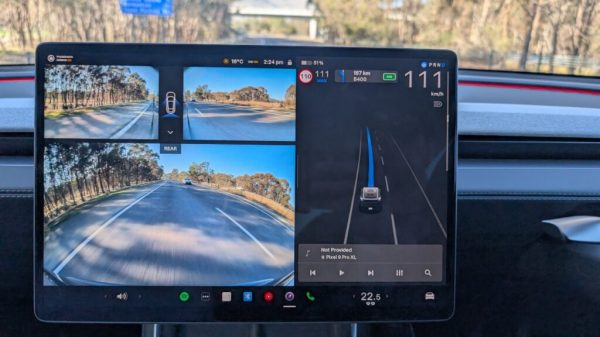
A newly installed front-facing camera improves parking and obstacle awareness. This camera is equipped with a washer function to remove road dirt, enhancing the overall driving experience. The camera system works seamlessly with Tesla’s HW4 computer, which facilitates the Enhanced Autopilot for a better driving experience.

Innovations in the Interior

The Model Y’s interior has undergone substantial improvements. The seats are now more supportive and feature improved ventilation, making them suitable for extended journeys. The air conditioning now includes a Swing feature, which maintains consistent airflow without creating chilly spots.

Smart Shift and Advanced Technology

Reintroducing the indicator stalk, Tesla has listened to user input, refining the driving interface. The Smart Shift feature intelligently determines driving direction based on object recognition, ensuring a modern and intuitive driving experience. The HW4 computer and the newest software significantly enhance navigation and Autopilot functions.

Experience on the Road

The newly designed suspension system in the Model Y improves ride comfort without sacrificing maneuverability. The vehicle features a heightened ride height and substantial suspension travel, boosting passenger accessibility and minimizing cabin noise.

Solutions for Storage

Storage capabilities are a highlight of the Model Y, offering a generous rear cargo area with a parcel shelf and a deep lower storage compartment. The frunk continues to be one of the largest in its category, providing extra storage solutions for different requirements.

Concluding Remarks

The latest Tesla Model Y merges cutting-edge technology with functional features, making it an attractive option for families in Australia. With a base price of A$64,373 and numerous upgrade possibilities, it balances luxury with affordability. Tesla’s current deals, including trade-in incentives and reduced prices on inventory, present additional reasons for prospective buyers to consider this model.

Overview

The latest Tesla Model Y showcases notable advancements in both design and technology that upgrade the driving experience. With enhancements in exterior design, interior comfort, and sophisticated driving functions, it emerges as a leading choice in the electric vehicle marketplace. The competitive pricing, coupled with Tesla’s promotional offerings, makes it an appealing selection for Australian buyers.

Q: What are the notable exterior features of the updated Model Y?

A: Notable exterior features comprise a full-width front light bar, revamped wheels, and a rear afterburner light bar, all contributing to the vehicle’s visual attractiveness.

Q: How does the upgraded camera system enhance driving?

A: The new front-facing camera assists with parking and obstacle detection, including a washing system for keeping the view clear and improving safety.

Q: What are the main updates to the interior?

A: Key interior upgrades consist of more comfortable and ventilated seating, the Swing air conditioning feature, and the comeback of the indicator stalk for better usability.

Q: Can you explain how the Smart Shift feature operates?

A: Smart Shift automatically determines driving direction using object recognition technology, enhancing convenience and adding a modern flair to driving.

Q: What distinguishes the driving experience in the Model Y?

A: The revised suspension system offers improved comfort and handling, while the vehicle’s construction minimizes cabin noise, creating a quieter ride.

Q: What storage capabilities are provided by the Model Y?

A: The Model Y features ample storage options, including a spacious rear cargo area, a deep lower storage compartment, and a sizable frunk for added utility.

Nokia Essential True Wireless Earphones (E3511) Review


We independently review everything we recommend. When you buy through our links, we may earn a commission which is paid directly to our Australia-based writers, editors, and support staff. Thank you for your support!

Nokia Essential True Wireless Earphones (E3511), Fully Wireless Earbuds, Bluetooth, Noise Cancellation, External Sound Capture / 25 Hours of Music Playback, Instant Connection, Hands-Free Calling

Microsoft Unveils Strategic Co-Investment in Defence’s Azure Integration


We independently review everything we recommend. When you buy through our links, we may earn a commission which is paid directly to our Australia-based writers, editors, and support staff. Thank you for your support!

Microsoft’s Collaborative Investment in Defence’s Azure Integration

Quick Overview

  • Microsoft and Defence work together for cloud implementation and digital change.
  • Data#3 engaged for a $495-million Azure services contract.
  • Enterprise Customer Investment Fund (ECIF) will back the project.
  • The investment is in line with Defence’s digital agenda and roadmap.
  • Funding encompasses pilots, cloud transitions, and prospective new Azure services.
  • Current priorities focus on SAP-centric ERP and the Microsoft 365 ecosystem.
Microsoft and Defence's Azure Integration

Details of the Co-Investment Program

Microsoft has revealed a strategic co-investment initiative with the Australian Department of Defence, concentrating on cloud adoption and digital evolution. This effort represents a substantial financial commitment, although specific amounts are kept confidential for commercial reasons.

Commitment to Azure Consumption with Data#3

Defence has engaged Data#3 for software and cloud services for the next five years, with a deal valued at $495 million. This contract forms part of a Microsoft Azure Consumption Commitment (MACC), highlighting the increased dependency on cloud solutions for national defence functions.

Enterprise Customer Investment Fund (ECIF)

The Enterprise Customer Investment Fund (ECIF) plays a crucial role in this collaboration. ECIF enables Microsoft to allocate budgetary resources to back its products and services, offering Defence financial support for cloud pilots, migrations, and training efforts. This fund is a rebranding of former business investment funds, signifying Microsoft’s changing approach to customer partnerships.

Strategic Alignment with Defence’s Digital Agenda

This co-investment bolsters Defence’s wider digital transformation aims, aligning with its digital strategy and secure cloud initiatives. The partnership aims to enhance Defence’s operational capabilities through advanced cloud technologies.

Ongoing Azure Programs: SAP ERP and Microsoft 365

Defence is progressing with two major Azure initiatives: a SAP-based enterprise resource planning (ERP) system and the Microsoft 365 environment branded as Vera. The ERP system has recently become operational with modules for logistics, maintenance, finance, and procurement, while the Vera environment is witnessing considerable expansion.

Conclusion

Microsoft’s collaboration with the Australian Department of Defence signifies a major investment in cloud-centric digital evolution. Through the ECIF and collaboration with Data#3, this initiative is poised to foster innovation and improve efficiency in Defence’s operations, aligning with its strategic digital pathway.

Q&A

Q: What is the main objective of Microsoft’s co-investment with Defence?

A: The main objective is to support Defence’s cloud adoption and digital transformation consistent with its digital strategy and roadmap.

Q: What is the function of the Enterprise Customer Investment Fund (ECIF) in this partnership?

A: The ECIF provides financial support for Defence’s cloud pilots, migration, and training efforts, facilitating the uptake of Azure services.

Q: How much is the Azure services agreement with Data#3 worth?

A: The agreement is valued at $495 million over a five-year period.

Q: What are the primary Azure initiatives currently underway for Defence?

A: The primary initiatives include a SAP-based ERP system and the Microsoft 365 environment known as Vera.

Q: How does this initiative correspond with Defence’s overall strategy?

A: It correlates with Defence’s digital transformation goals and secure cloud strategy, enhancing operational capacity through cloud innovations.

Innovative Guidelines Unveiled for Stackable Batteries


We independently review everything we recommend. When you buy through our links, we may earn a commission which is paid directly to our Australia-based writers, editors, and support staff. Thank you for your support!

  • Fresh guidance has emerged for solar battery storage in Australia.
  • STCs can now help lower the initial expenses of solar batteries.
  • Eligibility for stackable battery systems has been widened.
  • Revised guidelines for incorporating batteries with current solar PV systems.
  • New specifications for off-grid solar battery setups introduced.
  • Temporary increase in the maximum daily installations for solar systems.
  • STCs for solar batteries are available for trading on the open market.
New Guidelines for Stackable Batteries

Eligibility For Stackable Batteries

Australians aiming to improve their energy storage options have cause for excitement. The Clean Energy Regulator has revealed that new battery modules integrated into existing stackable battery systems can now qualify for Small-scale Technology Certificates (STCs). Comprehensive criteria and guidance can be located in the REC Registry, streamlining the process for consumers and installers alike.

Updates For Existing Solar PV Systems

For individuals with current solar PV systems, incorporating a solar battery is now governed by updated guidelines. These changes ensure that your system aligns with virtual power plants (VPPs), enabling participation in larger energy networks. This initiative aims to enhance current systems and promote involvement in Australia’s clean energy future.

Off-Grid Solar Battery Requirements

For Australians pursuing complete energy autonomy, new off-grid solar battery requirements offer clarity and support. These stipulations cover properties situated less than 1km from the grid and provide detailed guidance for integrating batteries into pre-existing off-grid systems. The intention is to facilitate the transition to off-grid living with seamless integration and dependability.

Maximum Daily Installations: A Temporary Boost

To ease installation delays, Solar Accreditation Australia has enacted temporary measures to increase maximum daily installations. From July 1 to August 10, 2025, installers can complete more systems each day, including a combination of solar battery and PV systems. This initiative targets the backlog and seeks to hasten the deployment of new setups.

STCs For Registered Agents

Registered agents working with solar batteries will continue to manage STCs smoothly. The Australian Government will acquire STCs corresponding to those generated by solar batteries, ensuring a stable market environment. These certificates are not required to be sold to the government, allowing for flexibility in trading on the open market.

The recent updates mark a significant advancement toward making solar battery storage a feasible option for Australian homes and businesses. With lower costs and easier processes, this moment could represent the ideal opportunity to invest in solar battery technology.

For additional information, visit the Clean Energy Regulator website.

Summary

Australia is progressing in making solar battery storage more accessible through new guidelines and STC incentives. Whether augmenting a current system or initiating a new installation, these updates promise to lower costs and simplify procedures, creating a favorable opportunity to adopt solar battery technology.

Q: What are Small-scale Technology Certificates (STCs)?

A: STCs are certificates that signify the environmental advantages of renewable energy systems and can help reduce the initial costs of solar batteries.

Q: How do the new guidelines affect existing solar PV systems?

A: The revised guidelines ensure that systems are compatible with virtual power plants, improving integration with wider energy networks.

Q: Can new battery modules be added to existing systems?

A: Absolutely, new battery modules integrated into stackable systems qualify for STCs, providing an incentive for system expansion.

Q: What measures are in place for off-grid solar batteries?

A: Specific criteria have been established for properties near the grid and for incorporating batteries into existing off-grid systems.

Q: Are there any temporary measures for solar system installations?

A: Yes, there is a temporary rise in the maximum daily installations permitted, which aids in addressing installation backlogs.

Q: How can STCs for solar batteries be traded?

A: STCs can be freely traded on the open market and are not required to be sold to the government or an STC clearing house.

Huawei FreeBuds 5i Review


We independently review everything we recommend. When you buy through our links, we may earn a commission which is paid directly to our Australia-based writers, editors, and support staff. Thank you for your support!

Huawei FreeBuds 5i Fully Wireless Earphones, High Resolution, ANC Calling Noise Reduction, Ceramic White