
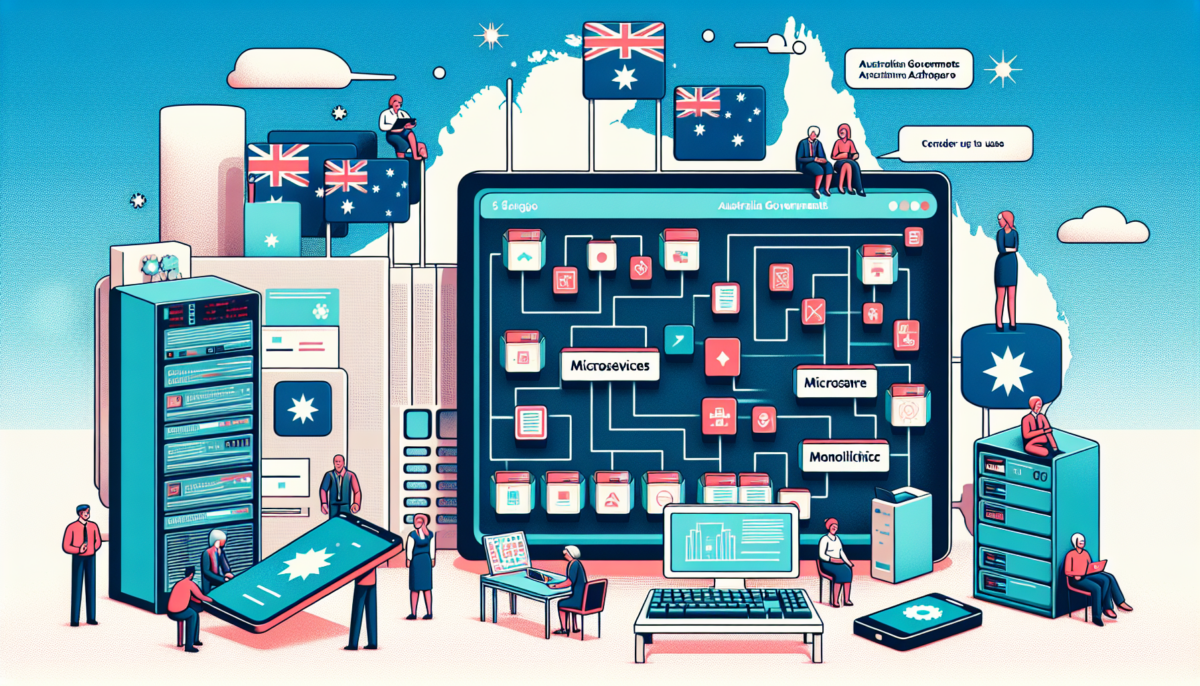
Aussie Governments Advocate for Microservices Instead of Monolithic Systems

We independently review everything we recommend. When you buy through our links, we may earn a commission which is paid directly to our Australia-based writers, editors, and support staff. Thank you for your support!
“`html
Quick Read
- Australian authorities are shifting from traditional systems to architectures based on microservices.
- Microservices provide adaptability, allowing smaller, agile companies to compete for government contracts.
- IT funding is decreasing while cybersecurity risks are increasing, driving this transition.
- Modernizing government involves reapplying microservices across departments to mitigate technological debt.
- Cutting-edge technologies such as AI and adaptive security are leading government IT spending.
- It is vital to retrain employees for digital functions to effectively deploy new technologies.
Australian Governments Embrace Microservices Over Traditional Systems
In the next five years, government operations could predominantly utilize agile microservices architectures, stated a prominent official from a Commonwealth agency at a recent assembly of peers.
Transitioning from Traditional to Microservices
“We are transitioning from a traditional tech framework to a collection of microservices,” Peter O’Halloran, chief digital officer of the Australian Digital Health Agency, conveyed during last month’s Tech in Gov conference in Canberra. This movement towards software systems built from targeted, manageable code segments is transforming governmental IT operations.
This trend is also visible in procurement activities. With dwindling budgets, escalating expectations, and cybersecurity concerns, Australian governments are searching for straightforward, ‘bite-sized’ technology solutions from nimble enterprises.
“The era of huge IT projects costing billions is over,” O’Halloran remarked. “Those days are behind us — and that’s likely a positive change.”
Modernization Challenges
O’Halloran highlighted that it is essential for government to modernize its systems, especially as disruptors like artificial intelligence (AI) and increasing citizen demands press agencies amid shrinking IT budgets. “Government was among the first to digitize numerous processes … thus, we carry a substantial amount of tech debt,” he stated during a panel discussion launching TechBest’s Public Sector Tech Report.
His observations echoed findings from the TechBest report, which indicated that, despite Australia’s impressive fifth place in the OECD’s 2023 Digital Government Index, two decades of legacies now hinder its future transformation.
Breaking Down IT Systems
To address these challenges, the public sector, including ADHA, aims to “break down” its IT systems, gradually dismantling legacy, traditional setups while reusing the same microservices across various agencies, O’Halloran explained. “You keep utilizing that function for similar applications so that over time, you create a singular tool for functions like authentication or user management. And keep enhancing those so that each time you secure funding for a new system, you can integrate with pre-existing elements you’ve modernized.
“After five years, you might realize, ‘Wow, our traditional tech architecture is halved’.” He expressed that the “next four or five procurements” for ADHA are pivotal: “And we’ll continue this on an annual basis until we eliminate the outdated tech debt we carry.”
New IT Philosophy Opens Doors for SMBs
A significant outcome of this newfound IT awareness is that smaller, agile companies previously excluded from large-scale government IT contracts can now compete for projects. IT market analyst, Gartner, noted that Australian governments could allocate as much as $27 billion for IT this year — about 60 percent at the federal level — with an annual increase of approximately 10 percent, making it collectively Australia’s largest purchaser.
O’Halloran mentioned that agencies are now open to engaging smaller, innovative suppliers with expertise in specific technologies. “We are trying to expand our supply base – looking for small enterprises that provide innovation as well as larger firms with experience in diverse products,” he stated. “Our goal is to unite the sector, harnessing innovation from all.”
Natalie Legg, CEO of Canberra systems integrator A23 and a former senior project manager at Treasury, shared O’Halloran’s perspective. She proposed that increased opportunities for smaller Australian enterprises could be a silver lining amid tightening government budgets.
“Large projects typically lead to a shortlist of just five companies capable of executing them. And we’ve seen — we are aware — of the consequences that result from this.”
Legg articulated that government agency buyers should demand evidence of competency from their suppliers: “Who has successfully executed that ‘task’ previously?” She added, “We rarely question: ‘Did they accomplish the ‘task’ they were engaged to deliver? Is it the ‘Emperor’s New Clothes’; are people ignoring the naked project in the room?”
She advised agencies to, “invest in small, agile firms that excel in these specific tasks and make that their primary focus.”
Predictions for Government Tech in 2026 – Insights Beyond AI
Gartner highlights that the emerging technologies for government procurement include adaptive security, digital identity, digital platform responsiveness, programmatic data management — alongside AI. The latter is particularly relevant for government leaders, as AI offers enhanced service delivery through various applications like chatbots, apps, and improved cybersecurity, yet agencies need personnel with advanced skills to effectively implement it.
O’Halloran stated that ADHA is retraining individuals with hands-on healthcare experience for digital roles. “They may not become expert programmers [but] as business analysts, change facilitators, and service designers, they are exceptional; they grasp our environment,” O’Halloran expressed. “Hence, I’m aiming to avoid recruitment from other organizations and instead cultivate our workforce … through individuals making mid-career transitions.”
Marcus D’Castro praised the public sector for its proactive stance compared to private sector counterparts, as it braces for an AI-driven future. “One area that stands out is data management — the consolidation, optimization, access, security, governance of data,” mentioned D’Castro, general manager at Nomura Research Institute (NRI).
“The old adage, ‘garbage in, garbage out’ has never been more applicable — if you supply Generative AI poor data, expect poor results.” He elaborated that the public sector’s approach to archival management places it “in a favorable position” to capitalize on upcoming opportunities. “The technical aspects are relatively straightforward; preparing your data to be ready and accessible is the more challenging endeavor.”
Summary
The Australian government is strategically shifting from traditional IT systems to microservices-based architectures, motivated by the need for adaptability, financial constraints, and escalating cybersecurity challenges. This transformation allows smaller, agile firms to secure government contracts and fosters a more innovative IT atmosphere. Focus on emerging technologies like AI, adaptive security, and digital identity are essential for future government IT investments.
“`
Reader questions
Frequently asked questions
Fast answers to the questions readers ask most about Aussie Governments Advocate for Microservices Instead of Monolithic Systems.
What are the primary drivers for the transition from traditional systems to microservices?
The transition is motivated by the necessity for adaptability, financial limitations, and increasing cybersecurity risks. Microservices facilitate more straightforward and versatile systems that can be easily modified and expanded.
What impact does this shift have on smaller enterprises?
Smaller, agile firms that were previously excluded from comprehensive government contracts can now successfully pursue projects. This creates opportunities for innovation and diversity in government IT initiatives.
Which emerging technologies are government agencies concentrating on?
Government agencies are emphasizing adaptive security, digital identity, digital platform agility, programmatic data management, and AI. These technologies promise significant advancements in service delivery.
