
Disproving the Green Electron Fallacy: The Reality of 100% Renewable Electric Vehicle Charging

We independently review everything we recommend. When you buy through our links, we may earn a commission which is paid directly to our Australia-based writers, editors, and support staff. Thank you for your support!
Quick Read
- The grid offset approach in EV charging is often utilized to assert that energy comes from 100% renewable sources.
- Large-scale Generation Certificates (LGCs) are vital to the offsetting process.
- Curbside charging stations are essential for enhancing EV adoption among city-based Australians lacking private parking spots.
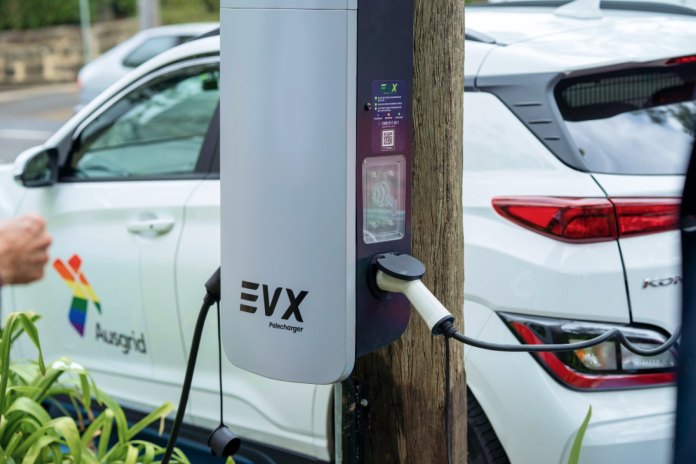
- EVX’s chargers mounted on poles provide a feasible solution for those living in apartments and rented accommodations.
- Comprehending the offset system is critical for establishing trust in claims about green energy.
- Currently, renewable energy constitutes 37% of Australia’s overall energy production.
The Great Electron Misunderstanding
A harmless post on Facebook by Federal Member for Bennelong, Jerome Laxale MP, recently ignited a heated discussion in the comments, revealing a significant misunderstanding within the Australian EV community. Laxale shared an image of a 22kW EVX pole-mounted charger located in North Ryde, celebrating the growth of curbside charging options funded by the NSW Government.
How the Offset Economy Keeps It Honest
When a charging network like EVX asserts it provides 100% clean power through the grid, it doesn’t entail that specific green electrons are directed to your vehicle’s charging point. Rather, a system of accounting aligns energy consumption with clean generation happening elsewhere. EVX utilizes software to monitor electricity usage and secures a corresponding quantity of certified renewable energy.
The Role of Large-scale Generation Certificates
In order to honor its green commitment, EVX computes the total consumption and procures an equivalent amount of renewable energy using Large-scale Generation Certificates (LGCs), which confirm that renewable energy has been generated and injected into the grid.
Why Curbside Charging is the Real Winner Here
Regardless of discussions surrounding energy sources, pole-mounted chargers present an outstanding solution for urban dwellers. They are affixed to existing utility poles, eliminating the requirement for expensive infrastructure. This is advantageous for Australians residing in apartments or rental units devoid of private charging options.
Understanding the Speed Limitations
Although a 22kW charger might appear fast, the majority of electric vehicles in Australia are restricted to 11kW for AC charging. Consequently, achieving a full charge can take numerous hours, which is suitable for overnight charging or quick top-ups during the day.
A Financial Win for Local Drivers
Curbside chargers are designed to be affordable, providing a budget-friendly alternative to high-cost ultra-fast highway stations. This keeps the running expenses for urban EVs lower than those of conventional petrol vehicles.
The Transparency Problem in Clean Tech
The ambiguity surrounding green energy claims highlights the necessity for marketing clarity. Clarifying the LGC system fosters trust in green energy assertions, as Australians are typically wary of corporate narratives.
The Grid is Transforming Whether You Like It or Not
Every instance a provider relinquishes an LGC to counterbalance EV charging, it creates a financial incentive for the development of solar and wind energy. This market-centric strategy is effectively enhancing Australia’s electricity sector.
Final Thoughts on On-street Charging
Jerome Laxale’s interaction in the comments stresses the need to tackle misunderstandings related to EV charging. As more pole-mounted charging stations are deployed, Australians can gain a clearer comprehension of the advantages of renewable offsets.
Summary
Grasping the offset process behind 100% renewable EV charging is essential for earning trust in green energy. With the expansion of curbside charging solutions, practical benefits are being offered to urban Australians, facilitating greater EV uptake.
Reader questions
Frequently asked questions
Fast answers to the questions readers ask most about Disproving the Green Electron Fallacy: The Reality of 100% Renewable Electric Vehicle Charging.
How does the grid offset method work?
The grid offset method guarantees enough renewable energy is contributed to the grid to balance the consumed energy, which is monitored through software.
What role do Large-scale Generation Certificates play?
LGCs confirm that renewable energy was produced and supplied to the grid, empowering energy suppliers to assert 100% renewable energy.
Why are curbside chargers important for urban Australians?
Curbside chargers offer charging opportunities for individuals without private parking access, making EVs more attainable for those living in apartments and rental homes.
Are 22kW chargers fast enough for most EVs?
Most EVs in Australia are capped at 11kW AC charging, thereby making a 22kW charger ideal for overnight charging or minor top-ups.
How do curbside chargers benefit local drivers financially?
They provide an economical alternative to high-priced ultra-fast stations, lowering the running expenses of urban EVs in comparison to petrol vehicles.
What is the current renewable energy share in Australia?
Renewable energy makes up 37% of Australia’s total energy output, with substantial contributions from both solar and wind sources.
