Australia Tech News - Page 65 of 151 - Techbest - Top Tech Reviews In Australia

Aptera’s Solar Vehicle Approaches Release, Guarantees Low Charging Requirements


We independently review everything we recommend. When you buy through our links, we may earn a commission which is paid directly to our Australia-based writers, editors, and support staff. Thank you for your support!

Aptera’s Solar Vehicle Approaches Launch, Promises Minimal Charging Requirements

Quick Overview

  • Aptera Motors is set to reveal its solar electric vehicle on June 28, 2025.
  • The vehicle boasts 700 watts of solar panels, delivering up to 64 km of range daily from sunlight.
  • Aerodynamic contours with a drag coefficient of 0.13 ensure high efficiency.
  • Constructed with lightweight carbon fibre and fibreglass composite materials.
  • Different battery choices offer ranges of up to 1,600 km.
  • Pricing in the US begins at $40,000, approximately A$60,000 for Australian buyers.

Launch of Aptera’s Solar Electric Vehicle

The US-based startup, Aptera Motors, is preparing to unveil its production-ready solar electric vehicle. The highly anticipated reveal will occur during a YouTube Live stream on June 28th, 2025, at 8:00 AM AEST. This occasion represents a notable achievement for Aptera, as the vehicle comes outfitted with features anticipated by prospective owners, including advanced climate control, an infotainment system, and an innovative vision system fully integrated with solar technology.

Aptera's solar-powered car is on the brink of arrival, requiring very little charging

Interest and Reservations

Aptera has already accumulated close to 50,000 reservations for its groundbreaking three-wheeler, highlighting strong market interest. Co-CEOs Chris Anthony and Steve Fambro express faith in their in-house design and technology framework, which achieves unmatched energy efficiency.

National Road Tour and Practical Testing

After the launch, Aptera intends to undertake a cross-country road tour across the US. This trip will act as a practical examination of the vehicle’s solar-powered capabilities, yielding valuable performance data critical for validating the car’s efficacy as the company strides toward making solar mobility a reality for customers.

Never Charge Feature

The Aptera differentiates itself through its solar energy potential. Fitted with 700 watts of proprietary solar cells, the vehicle can generate up to 64 kilometres of driving range daily from sunlight alone, potentially removing the need for charging for many drivers’ daily travels.

Exceptional Aerodynamics

The Aptera’s teardrop shape is crafted for optimal efficiency, showcasing a drag coefficient of merely 0.13. This remarkable aerodynamic capability contributes to its extensive range, attainable with a comparatively small battery.

Lightweight Design

The chassis of the vehicle is made from lightweight carbon fibre and fibreglass composite materials, resulting in an overall weight of about 816kg. This weight reduction is vital for its superior energy efficiency.

Extended Range Choices

For longer voyages, Aptera will provide various battery options, with the premium model offering a range of up to 1,600 kilometres on a single charge. The initial Launch Edition is anticipated to deliver a range of approximately 640 kilometres, adequate for most long trips.

Pricing and Availability in Australia

Although Aptera has yet to announce official pricing or release dates for Australia, they are investigating the necessary regulations to introduce the vehicle into the Australian market. The US pricing for the Launch Edition is about $40,000, equating to roughly A$60,000, although this figure may vary based on local taxes and import duties.

For further details, visit Aptera’s official website.

Conclusion

Aptera Motors is on the verge of transforming the automotive sector with its solar electric vehicle. Focusing on solar energy, aerodynamics, and lightweight design, the Aptera offers an unparalleled driving experience with minimal charging needs. As they gear up for the vehicle’s launch and national testing, the company is positioned to make significant advancements in sustainable transportation.


FAQs

Q: When will Aptera’s solar car be released?

A: The launch is slated for June 28th, 2025, during a YouTube Live presentation.

Q: What distance can the Aptera solar car cover using solar power?

A: The vehicle can achieve up to 64 kilometres of range daily from sunlight.

Q: What is the anticipated cost of Aptera’s solar car in Australia?

A: The US price is around $40,000, approximately A$60,000 in Australia, not including taxes and import fees.

Q: How does the Aptera attain high energy efficiency?

A: The car’s energy efficiency stems from its aerodynamic design, lightweight structure, and integrated solar technology.

Q: What battery range options does the Aptera provide?

A: The Aptera presents multiple battery options, with the top model achieving up to 1,600 kilometres on a single charge.

The Internet’s Fundamental Guardian: An Indispensable Requirement


We independently review everything we recommend. When you buy through our links, we may earn a commission which is paid directly to our Australia-based writers, editors, and support staff. Thank you for your support!

Grasping the Significance of DNS Security: Essential for Contemporary Cyber Defense

Brief Overview

  • DNS acts as the vital directory of the internet, essential for finding websites.
  • DNS protection and protective DNS are separate methodologies yielding varied results.
  • DNS protection is a reactive strategy, centered on fortifying the infrastructure against threats.
  • Protective DNS takes proactive measures to detect and thwart harmful activities.
  • Australia is making strides in DNS security, yet legislative advancements are required for protective DNS.
  • A staggering 92% of cyberattacks utilize DNS, highlighting the necessity for strong DNS security protocols.

The Function of DNS in Cybersecurity

DNS as a vital gatekeeper of the internet

In today’s digital era, the Domain Name System (DNS) is the foundation of online navigation, enabling effortless access to websites. Nonetheless, its pivotal role also renders it susceptible to cyber threats. Grasping and enforcing effective DNS security is crucial for protecting both individual and organizational information.

Comparing DNS Protection to Protective DNS

Clarifying the Distinctions

Though commonly used interchangeably, DNS protection and protective DNS denote different methodologies in the realm of cybersecurity. DNS protection is aimed at securing the infrastructure, primarily against distributed denial-of-service (DDoS) attacks. It serves as a reactive tactic, initiated in response to threats.

The Proactive Nature of Protective DNS

In contrast, protective DNS adopts a proactive approach. It detects and prevents malicious actions at the infrastructure level prior to inflicting damage. This strategy significantly decreases false positives and bolsters network security by obstructing access to harmful domains.

Legislative Hurdles and Advancements

International and Domestic Initiatives

On a global scale, the significance of DNS security is increasingly acknowledged. The US National Institute of Standards and Technology (NIST) has released directives for securing DNS, while the UK’s National Cyber Security Centre endorses protective DNS for network safeguarding. In Australia, the Australian Signals Directorate’s Essential Eight categorizes DNS protection as a vital strategy, and the Security of Critical Infrastructure (SOCI) Act recognizes DNS as an essential asset.

The Demand for Protective DNS Legislation

Despite these developments, there is an urgent requirement for enforceable legislative frameworks supporting protective DNS. With 92% of cyberattacks exploiting DNS, protective DNS ought to be a foundational element of cybersecurity legislation. This will guarantee that organizations can effectively thwart, identify, and respond to threats.

Conclusion

DNS security stands as a crucial element of contemporary cybersecurity frameworks. While DNS protection permits a reactive defense against threats, protective DNS offers proactive strategies to avert attacks before they take place. As cyber threats keep evolving, embracing protective DNS will be vital for organizations to uphold strong security measures and comply with forthcoming legislative standards.

Q: What distinguishes DNS protection from protective DNS?

A: DNS protection is a reactive measure aimed at securing the DNS infrastructure, while protective DNS is proactive, detecting and preventing threats preemptively.

Q: What is the significance of DNS security?

A: DNS security is essential as it stops unauthorized access and assaults on the critical internet navigation system, safeguarding data and sustaining network integrity.

Q: How is Australia tackling DNS security?

A: Australia is progressing in DNS security through guidance from the Australian Signals Directorate and acknowledging DNS as a pivotal asset in the SOCI Act.

Q: What is the necessity for protective DNS legislation?

A: Protective DNS legislation is crucial to ensure organizations implement proactive strategies against cyberattacks, given that DNS is implicated in 92% of assaults.

Victoria’s First Government Technology Head Steps Down


We independently review everything we recommend. When you buy through our links, we may earn a commission which is paid directly to our Australia-based writers, editors, and support staff. Thank you for your support!

Victoria’s Technology Chief Resigns

Brief Overview

  • Victoria’s inaugural technology leader, Luke Halliday, steps down after three years.
  • Halliday was vital in modernizing government services and spearheading IT evolution.
  • The Department of Government Services (DGS) was established under his guidance.
  • Dovid Clarke will temporarily serve as interim CTO while a successor is found.
  • Halliday has shifted to the private sector.

Change in Leadership within Victoria’s Tech Governance

Victoria's inaugural government technology head resigns

Luke Halliday’s Impact at Digital Victoria

Starting his journey as the chief technology officer of Digital Victoria in 2022, Luke Halliday has officially announced his resignation. Entrusted with the modernization of government services and guiding IT transformation, Halliday’s efforts have been crucial in reshaping the digital framework of Victoria.

The Establishment of the Department of Government Services

In 2023, with the formation of the Department of Government Services (DGS), Halliday’s responsibilities expanded. This newly created department took over many of Digital Victoria’s responsibilities, with Halliday playing a crucial role in building its IT infrastructure. His contributions included team integrations from Service Victoria and developing the state’s ICT strategy.

Temporary Leadership and Outlook for the Future

As the search for Halliday’s replacement proceeds, Dovid Clarke, Victoria’s whole-of-government chief information security officer, will temporarily occupy the CTO role. This leadership transition represents a significant moment for the DGS as it continues to build on Halliday’s foundational work.

Insights and Future Ventures

Having transitioned to the private sector, Halliday leaves behind a legacy of creativity and unification. Reflecting on his time, he stated on LinkedIn, “This has been one of the most fulfilling segments of my career for what we achieved and learned. Government work is frequently misjudged. It’s not simple, nor purposely drawn out. It’s immensely intricate. Nonetheless, within departments, I observed individuals dedicating themselves daily to improving outcomes.”

Conclusion

Luke Halliday’s exit signifies the conclusion of a transformative phase in Victoria’s technology governance. His leadership in modernizing and integrating digital services has set a new benchmark for the state’s ICT strategy, and his transition to the private sector underscores the evolving landscape of technology leadership.

Q: Who is Luke Halliday?

A: Luke Halliday was the first technology leader for Victoria’s whole-of-government, serving as the chief technology officer for Digital Victoria.

Q: What was Halliday’s main responsibility?

A: Halliday’s primary responsibility was to modernize government services and oversee IT transformation projects.

Q: What is the Department of Government Services?

A: The Department of Government Services (DGS) is a newly created department that took over several functions from Digital Victoria, focused on improving IT services throughout the government.

Q: Who will serve as interim CTO?

A: Dovid Clarke, the chief information security officer for Victoria’s whole-of-government, will serve as interim CTO.

Q: What did Halliday accomplish during his tenure?

A: Halliday was instrumental in modernizing IT services, merging various teams, and formulating Victoria’s ICT strategy.

Q: What are Halliday’s future plans?

A: Halliday has moved to the private sector, although specific details about his new role remain undisclosed.

Tesla’s Completely Self-Driving Robotaxi Takes to the Roads in a Revolutionary Debut.


We independently review everything we recommend. When you buy through our links, we may earn a commission which is paid directly to our Australia-based writers, editors, and support staff. Thank you for your support!

Tesla’s Fully Autonomous Robotaxi Debut: A New Era in Transportation

Quick Overview

  • Tesla has introduced its fully autonomous Robotaxi service in Austin, Texas.
  • Elon Musk and Kimbal Musk have praised the Tesla AI team for their accomplishment.
  • The initial area for the Robotaxi service is less extensive than competitors such as Waymo.
  • Early access passengers are utilizing the specialized Robotaxi mobile application.
  • Early access ride pricing is set at a fixed rate of $4.20.
  • The service currently operates in a limited area but is anticipated to grow quickly.

Overview of Tesla’s Robotaxi

Tesla has officially rolled out its long-awaited fully autonomous Robotaxi service in Austin, Texas. This launch represents a major achievement for the Tesla AI team, which has been developing this technology for ten years. Elon Musk, Tesla’s CEO, took to social media to convey his congratulations to both the software and hardware teams for this milestone.

Tesla's Fully Autonomous Robotaxi in Action

Initial Impressions and Feedback

Initial users of the Robotaxi have shared their feedback online, emphasizing the smooth app interface and distinctive rider experiences. A user named Zack posted a video demonstrating the app’s tipping feature, playfully showcasing a Cyber-themed Hedgehog instead of a typical tip-processing unit, reflecting Tesla’s commitment to enhancing user experience.

Geographical Limitations and Coverage Area

The starting service area for Tesla’s Robotaxi is somewhat restricted, encompassing about half of what Waymo services in Austin. Nevertheless, Tesla is anticipated to quickly expand this coverage as the service gains momentum and collects additional data.

Robotaxi App and Branding Strategy

The newly launched Robotaxi mobile app is accessible for early access passengers, offering an intuitive interface for ride bookings. Tesla has implemented a discreet branding strategy for the Robotaxis, featuring the logo in a subtle manner, as all bookings occur via the app.

Pricing Structure and Economic Implications

Within the Early Access Program, rides are charged at a standard rate of $4.20, although the final pricing structure, which may take into account factors like distance and duration, has not yet been announced. This pricing approach positions Tesla favorably in the autonomous ride-hailing sector.

Conclusion

The launch of Tesla’s fully autonomous Robotaxi marks a revolutionary advancement in the transportation sector. By harnessing cutting-edge AI and a user-centric mobile app, Tesla aims to transform urban mobility. With intentions to broaden service areas and fine-tune pricing models, Tesla is focused on making autonomous transportation available to a larger population.

Questions and Answers

Q: What distinguishes Tesla’s Robotaxi from other autonomous vehicles?

A:

Tesla’s Robotaxi deploys sophisticated in-house developed AI along with a specially designed chip, resulting in a completely autonomous experience that eliminates the need for a driver.

Q: How can passengers request a Tesla Robotaxi?

A:

Passengers can arrange for a Tesla Robotaxi through the dedicated Robotaxi mobile app, which provides an accessible interface for booking and managing rides.

Q: What is the starting service area for Tesla’s Robotaxi?

A:

The initial service coverage is currently confined to a section of Austin, Texas, but further expansion is anticipated as Tesla gathers more data and enhances its service offerings.

Q: What is the fare for a ride in a Tesla Robotaxi?

A:

During the Early Access Program, rides incur a standard fee of $4.20, though the ultimate pricing model has yet to be finalized.

Q: Are there any special features in the Tesla Robotaxi experience?

A:

Indeed, the Tesla Robotaxi includes a rear-screen welcome for riders, and the app features a whimsical tipping option with a Cyber-themed Hedgehog graphic for user interaction.

Services Australia Revamps Intranet Due to Disjointed Internal Information Accessibility


We independently review everything we recommend. When you buy through our links, we may earn a commission which is paid directly to our Australia-based writers, editors, and support staff. Thank you for your support!

Brief Overview

  • Services Australia plans to reintroduce its M365 SharePoint-based intranet in mid-July.
  • The new design intends to establish the intranet as the key resource for operational data.
  • Key objectives of the redesign include personalisation and focused content delivery.
  • The intranet faces competition from other internal communication tools.
  • Diverse yet constructive feedback gathered from alpha testing will inform the redesign.
  • Microsoft Copilot could improve search functionality and data accessibility in the future.
  • The agency is anticipating advancements from Microsoft, such as an upgraded calendar app and dark mode.

Services Australia Set to Revise Intranet with Personalisation at its Core

Services Australia is preparing to relaunch its M365 SharePoint-based intranet in mid-July, with the goal of reinstating it as the central point for operational information within the agency. The redesign aims to tackle challenges of fragmented access to internal information and redundancy, positioning the intranet as the “principal source of truth” for staff.

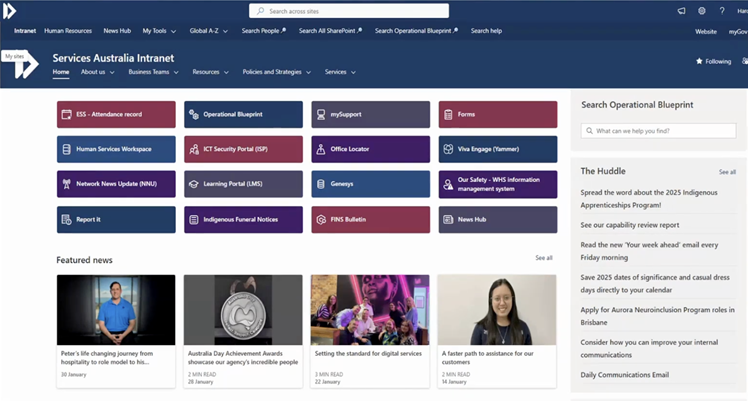
Services Australia updates intranet for better information access

Image credit: Services Australia/Swoop

Tackling Internal Communication Issues

Jillian Harding, Director of executive communication and events, noted at the SharePoint Intranet Festival that internal research indicated the intranet competes with platforms like Viva Engage. The agency faces a systemic issue of information overload and redundancy, which the redesign aims to alleviate.

Emphasising Personalisation and Targeted Content

The redesign prioritises the personalisation of the intranet experience and the targeting of content to distinct user groups. Harding expressed optimism that these changes will lessen the necessity for localised information management across the agency, enabling business units to publish and target content more efficiently.

Challenges in Feedback and Customisation

Michael Papacharalambous, assistant director of the intranet project, stressed the careful and iterative process undertaken during the redesign. Feedback from alpha testing was varied yet invaluable, underscoring the importance of customisation to cater to the specific needs of the agency’s 20,000 service delivery personnel.

Looking Forward: Beta Testing and Enhancements

The beta stage is scheduled for June, involving a larger user group to trial the new functionalities. Although a mid-July launch is the target, timing may be adjusted due to the end-of-financial-year workload. Anticipated future improvements may include Microsoft Copilot integration and long-term technical advances from Microsoft, such as an enhanced calendar app and dark mode for greater accessibility.

Conclusion

The intranet overhaul by Services Australia aims to centralise operational information, minimise overload, and boost personalisation for various user groups. Through addressing feedback and implementing necessary customisations, the agency seeks to significantly enhance the user experience.

Q: What is the primary objective of the intranet redesign?

A: The primary objective is to position the intranet as the main source of truth for operational information while reducing information overload and redundancy.

Q: How does Services Australia intend to personalise the intranet?

A: The agency aims to provide targeted content delivery and enable business areas to publish and target content for specific user groups.

Q: What feedback was gathered during the alpha testing phase?

A: The feedback was diverse but pointed out the necessity for clear navigation and easy access to frequently used links, particularly for service delivery staff.

Q: What future enhancements are expected?

A: Anticipated future enhancements may involve Microsoft Copilot integration for improved search capabilities and technical advancements such as a more sophisticated calendar app and dark mode for accessibility.

Queensland Government Appoints Acting Chief Information Security Officer


We independently review everything we recommend. When you buy through our links, we may earn a commission which is paid directly to our Australia-based writers, editors, and support staff. Thank you for your support!

Queensland Government Names Interim CISO

Quick Overview

  • Adam Smith appointed interim Chief Information Security Officer (CISO) for Queensland.
  • Rob Champion retires after seven years in the role of state government CISO.
  • Smith has previously worked as Deputy CISO.
  • Champion has a career marked by numerous significant IT security positions.
  • Queensland is set to confront persistent cyber security threats.

Adam Smith’s Appointment as Interim CISO

The Queensland government has revealed that Adam Smith will serve as its interim Chief Information Security Officer (CISO). Smith takes over after the retirement of Rob Champion, who held the position for seven years. A representative from the Department of Customer Services, Open Data, and Small and Family Business confirmed the news to TechBest.

QLD government names interim CISO

Rob Champion’s Impact

Rob Champion leaves behind a prominent legacy, having played a key role in developing a solid cyber security framework for Queensland. In his parting message on LinkedIn, Champion appreciated the chance to serve and recognized the combined efforts of his team and partners. He noted that Queensland is well-prepared to confront ongoing cyber security issues.

Highlights from Champion’s Career

Champion’s journey with the Queensland government began in 1991, during which he occupied various crucial roles across sectors. He notably held the position of executive director of the cyber security unit for over four years and worked on whole-of-government digital projects at CITEC. His talent also took him to the UK, where he collaborated with Harvey Nichols, a high-end department store.

Prospects for Cyber Security in Queensland

Thanks to Champion’s strategic foresight and leadership, Queensland is ready to effectively navigate the changing cyber security environment. With Adam Smith assuming the interim CISO position, the state is focused on continuing to enhance its cyber defenses and collaboration among security stakeholders.

Conclusion

The transition in leadership within Queensland’s cyber security division signifies a new beginning, with Adam Smith stepping into the interim CISO position. Rob Champion’s departure marks the end of an important chapter filled with considerable contributions to the state’s cyber preparedness. Queensland is dedicated to improving its initiatives to combat cyber threats under Smith’s interim guidance.

Q & A

Q: Who has been appointed as the new interim Chief Information Security Officer for Queensland?

A: Adam Smith has been named the interim Chief Information Security Officer for Queensland.

Q: For how long did Rob Champion serve as the CISO of the state?

A: Rob Champion held the position of state CISO for seven years.

Q: What positions did Rob Champion hold prior to becoming CISO?

A: Prior to his role as CISO, Champion held several IT security positions, including executive director of the cyber security unit and roles at CITEC and Harvey Nichols.

Q: How is Queensland positioned to tackle upcoming cyber security challenges?

A: Queensland is in a strong position to manage future cyber security challenges thanks to the solid framework and teamwork developed during Champion’s period of service.

Q: What future directions is Queensland’s cyber security strategy expected to take?

A: Under the interim leadership of Adam Smith, Queensland intends to keep improving its cyber security strategies and strengthening its defenses against ongoing threats.

Tesla Launches Robotaxi Service: Prepared for Operation with State-of-the-Art Technology


We independently review everything we recommend. When you buy through our links, we may earn a commission which is paid directly to our Australia-based writers, editors, and support staff. Thank you for your support!

Tesla’s Robotaxi Initiative Launches in Austin

Quick Overview

  • Tesla initiates its Robotaxi service in Austin, Texas.
  • Exclusive Early Access extended to a chosen group of individuals.
  • The service utilizes Tesla Model Y vehicles without extra hardware alterations.
  • The initial launch is confined to a geofenced region with defined service hours.
  • A Tesla employee will ride along during initial trips for safety precaution.
  • Input from passengers is essential for enhancing the service.
  • Tesla intends to broaden the service throughout the US by 2025.

First Public Rides in Austin

Today signifies a pivotal moment for Tesla as it officially rolls out its Robotaxi service in Austin, Texas. This landmark occasion provides the public with the opportunity to ride in Tesla’s self-driving vehicles on public streets.

Tesla reveals autonomous Robotaxi service set for action with cutting-edge technology

Early Access Program

A handpicked group of individuals has received Early Access to the service. This group consists of 15 individuals, many of whom participated in the early stages of Tesla’s Full Self-Driving (FSD) Beta. These early users are expected to contribute invaluable feedback as the service progresses.

Participation Costs

Early users are not just paying for their Robotaxi rides but are also responsible for their travel costs to Austin. This investment highlights the excitement surrounding Tesla’s launch.

Personalised Experience

Tesla has contacted invitees to gather their cloud profile preferences, ensuring a customised experience. Preferences regarding climate control and music choices will eventually sync with the Robotaxi rides.

Dedicated Robotaxi Application

Presently, Tesla is employing a dedicated Robotaxi App for the service. Nonetheless, there are plans to merge this with the current Tesla app, creating a unified experience for all users in the Tesla ecosystem.

Geofenced Operations

For the initial phase, the Robotaxi service functions within a designated geofenced area in Austin. This controlled setting will aid Tesla in managing the fleet and ensuring a smooth introduction before broader expansion.

Operational Hours

The service operates from 6:00 AM to 12:00 AM, every day of the week. Tesla indicates that these hours could be adjusted, particularly during severe weather conditions.

Safety Measures

A Tesla employee will be seated in the front passenger position during initial rides to ensure safety and compliance with regulations. This initiative will also manage vehicle charging needs until the arrival of Tesla’s Cybercab wireless charging.

Sharing Experiences

Riders are encouraged to document and share their Robotaxi experiences, contributing to the clarity and enthusiasm surrounding the service’s launch.

Plans for Future Expansion

This launch is merely the start of Tesla’s ambitious vision for its Robotaxi network. With successful operations, Tesla seeks to extend the service throughout the US by the end of 2025, with global expansions expected in 2026.

Conclusion

The launch of Tesla’s Robotaxi service in Austin signifies a new chapter in autonomous driving. With an emphasis on safety, rider feedback, and gradual expansion, Tesla is positioned to transform urban transportation.

Q: What is the importance of Tesla’s Robotaxi launch?

A: It represents the first public use of Tesla’s autonomous vehicles, highlighting the readiness of their technology for a wider deployment.

Q: Who can access the initial Robotaxi rides?

A: A select group of individuals, including early testers of Tesla’s FSD Beta, have been permitted Early Access.

Q: What are the operational constraints of the Robotaxi service?

A: The service functions within a geofenced region in Austin with specified service hours, and a Tesla employee is present for safety.

Q: How does Tesla intend to grow the Robotaxi service?

A: Tesla plans to expand the service across the US by 2025 and aims for international expansions by 2026.

Q: What role does feedback play in the Robotaxi service?

A: Rider feedback is vital for enhancing the service and facilitating a smooth transition to broader deployment.

Q: How does Tesla create a personalised experience for riders?

A: Tesla collects cloud profile preferences to customise the ride experience, with intentions for complete integration into the Tesla app.

Q: Why is a Tesla employee present during the rides?

A: The employee ensures safety, compliance with regulations, and manages vehicle charging needs.

Microsoft to Cut Thousands of Sales Positions in Significant Workforce Restructuring


We independently review everything we recommend. When you buy through our links, we may earn a commission which is paid directly to our Australia-based writers, editors, and support staff. Thank you for your support!

Microsoft Workforce Overhaul: AI Funding and Job Reductions

Brief Overview

  • Microsoft is gearing up to eliminate thousands of roles, primarily in sales.
  • The organization is amplifying its investments in artificial intelligence.
  • Earlier layoffs in May impacted around 6000 staff members.
  • A capital outlay of US$80 billion ($123 billion) is anticipated for data centre development.
  • Job reductions are predicted to be revealed at the start of next month.
  • These alterations are part of Microsoft’s plan to maintain its competitive stance in AI.

Microsoft’s Workforce Strategy Realignment

Microsoft plans significant workforce reorganization with job reductions in sales

Microsoft is set to carry out a considerable workforce reorganization, cutting down thousands of jobs chiefly within its sales division. This strategy is a component of its larger framework to escalate investments in artificial intelligence (AI). The tech titan, with a workforce tally of 228,000 as of June the previous year, intends to bolster its competitive position by more thoroughly embedding AI within its operations and services.

AI Investment: The Catalyst

As sectors globally increasingly weave AI into their offerings, Microsoft is reaffirming its commitment to AI investments. With a proposed capital expenditure of US$80 billion ($123 billion) for the ongoing fiscal year, most of these resources will concentrate on the growth of data centres. This development is crucial for alleviating capacity constraints, enabling Microsoft to fulfill the rising demand for AI offerings.

Broader Impact

Although the downsizing primarily targets the sales department, the repercussions are likely to extend to additional divisions as well. The timing of these job cuts coincides with the end of Microsoft’s fiscal year, although the precise timing remains adaptable.

AI Adoption Across the Industry

Microsoft’s strategic transition reflects a larger trend within the industry. Recently, Amazon’s CEO Andy Jassy emphasized that the application of generative AI and automated agents could result in a decrease in its corporate workforce in the coming years. This highlights a significant shift towards AI-enhanced efficiencies throughout the technology sector.

Conclusion

In an effort to solidify its role as a frontrunner in AI, Microsoft is reorganizing its workforce, with substantial job cuts within the sales division. This initiative aligns with considerable investments in AI and expansions of data centres, mirroring a broader trend in the industry toward AI integration.

Q: What is the rationale behind Microsoft’s job cuts?

A: Microsoft is reducing its workforce to optimize operations as it enhances its investments in artificial intelligence, ensuring readiness for future expansion.

Q: How many workers were impacted by the last wave of layoffs?

A: Approximately 6000 employees were affected by the previous layoffs in May.

Q: Where will Microsoft’s current capital expenditures be directed?

A: Microsoft’s capital expenditure of US$80 billion ($123 billion) will largely be aimed at the development of data centres to facilitate AI services.

Q: Are the job reductions limited to the sales department?

A: While the sales division will see substantial impacts, job cuts are expected to influence other departments as well.

Q: How does Microsoft’s strategy compare to that of other technology firms?

A: Similar to Microsoft, other technology firms like Amazon are also concentrating on AI integration, which could lead to workforce reductions.

Q: What is the expected timeline for the job cuts announcement?

A: The announcement regarding layoffs is anticipated to occur early next month, coinciding with the conclusion of Microsoft’s fiscal year.

Snap’s Upcoming Generation of Spectacles Scheduled to Launch in 2026 as Independent AR Devices


We independently review everything we recommend. When you buy through our links, we may earn a commission which is paid directly to our Australia-based writers, editors, and support staff. Thank you for your support!

Quick Read

  • Snap’s upcoming Spectacles, referred to as Specs, will launch in 2026.
  • Completely autonomous AR computer without the need for a phone.
  • Features cutting-edge dual 3D waveguide displays.
  • AI integration through collaborations with OpenAI and Google’s Gemini.
  • A developer community of 400,000 backed with new resources.
  • Significant collaboration with Niantic for AR experiences based on location.
  • Specifics on Australian launch date and pricing still pending announcement.

Snap’s Bold Move into Augmented Reality

Snap Inc. is poised to transform augmented reality with its next-gen Spectacles, known simply as Specs, set for release to the public in 2026. This milestone follows over ten years of advancements and a substantial investment surpassing A$4.5 billion.

An Independent AR Computer

In contrast to current smart glasses dependent on external devices, Specs are entirely self-sufficient. Driven by Snap OS, they deliver a genuinely wearable computing experience free of wires.

Innovative Optics and Display

At the heart of Specs are dual 3D waveguide displays that project digital information onto the physical environment. With enhancements in the optical engine, the device achieves a dynamic brightness of up to 2000 nits, providing vivid AR visuals in any context.

AI as a Fundamental Component

Artificial intelligence serves as a foundational element of Specs, featuring multimodal functions through OpenAI and Google’s Gemini. Users can access functionalities such as object detection, language translation, and smart recipe ideas, all in real-time.

A Robust Developer Framework

Snap empowers its extensive developer network with advanced resources like the Depth Module API and Automated Speech Recognition API, facilitating the development of engaging AR experiences.

Snap's upcoming standalone AR glasses

Designed for Shared Engagement

Focusing on social engagement, Snap is crafting tools for multiplayer gaming and cooperative AR experiences, leveraging the advantages of Snapchat’s social ecosystem.

Location-Based AR Unleashed

Through a collaboration with Niantic, Specs will incorporate a shared, AI-enhanced map for continuous, location-centric AR interactions, enriching real-life engagement.

Release and Pricing Information

While Specs target the consumer market for a 2026 launch, precise details regarding availability and pricing in Australia have yet to be revealed.

For additional details, visit https://www.spectacles.com/

Overview

Snap Inc.’s Specs signify a major advancement in AR technology, boasting standalone functionality, sophisticated optics, and extensive AI incorporation. Their anticipated 2026 launch aims to position Snap ahead of large tech firms in the AR domain, providing a thriving developer environment and a strong emphasis on social interaction.

Q&A Section

Q: What distinguishes Snap’s Specs from other smart glasses?

A: Specs function as completely autonomous AR devices, unlike others that depend on smartphone connections or additional equipment.

Q: In what way does Snap utilize AI within Specs?

A: AI is infused through partnerships with OpenAI and Google’s Gemini, providing instantaneous features such as object analysis and language translation.

Q: What assistance is offered to developers?

A: Developers can access new tools including the Depth Module API and Automated Speech Recognition API for crafting engaging AR experiences.

Q: When will Specs launch in Australia?

A: An exact date and pricing for the Australian market remain unannounced.

Q: How does Snap intend to boost social engagement with Specs?

A: Snap is developing tools for multiplayer gaming and joint experiences, tapping into Snapchat’s social platform advantages.

Q: What is the importance of Snap’s collaboration with Niantic?

A: This partnership allows for shared, location-aware AR experiences through a collaborative AI-driven map.

Adairs Introduces State-of-the-Art Technological Framework to Transform Supply Chain


We independently review everything we recommend. When you buy through our links, we may earn a commission which is paid directly to our Australia-based writers, editors, and support staff. Thank you for your support!

Adairs Revolutionizes Supply Chain with Advanced Technology

Quick Overview

  • Adairs has transitioned from a third-party logistics framework to managing its supply chain directly.
  • This change brings enhanced oversight of costs, efficiency, and customer interactions.
  • Implemented Manhattan Scale warehouse management solution over the past year.
  • Realized a 24% boost in ecommerce order fulfillment rates.
  • Handled 17% more inbound volume, supplying one million additional units to retailers.

Adairs’ Strategic Transformation in Supply Chain Management

The Australian homewares and decor retailer Adairs has made a significant move by shifting from a third-party logistics (3PL) framework to overseeing its supply chain internally. This strategic alteration aims to improve operational oversight, cost efficiency, and customer service.

Adairs implements technology framework in supply chain overhaul

Image credit: Adairs

The Impact of Manhattan Scale

To support this transition, Adairs adopted the Manhattan Scale warehouse management system over a 12-month timeframe, going live in July of the previous year. This system has been crucial in optimizing operations, enhancing inventory management, and adapting to peak demand.

Noteworthy Achievements and Cost Efficiency

Post-transformation, Adairs has reported an additional one million units delivered to retail locations compared to the prior year. Ecommerce order fulfillment surged by 24%, and the volume of inbound goods processed increased by 17%. Centralizing order fulfillment in a single distribution center has also resulted in considerable cost efficiencies.

Conclusion

Adairs’ initiative to regain oversight of its supply chain has proven to be transformative, delivering enhanced efficiency, notable cost reductions, and improved customer satisfaction. By utilizing state-of-the-art technology, the retailer has positioned itself to more effectively meet customer needs and manage increased demand.

Q: What was the main reason for Adairs altering its supply chain model?

A: The main reason was to gain improved operational oversight, enhance efficiency, and elevate the customer experience.

Q: Which technology did Adairs adopt to facilitate this change?

A: Adairs adopted the Manhattan Scale warehouse management system to assist the transition.

Q: What advancements were noticed following the supply chain transformation?

A: Adairs reported delivering one million additional units to stores, a 24% rise in ecommerce fulfillment, and a 17% increase in processed inbound volume.

Q: How has this change affected Adairs’ cost savings?

A: By fulfilling orders from a single distribution center, Adairs has realized substantial cost savings.

Q: When did the new warehouse management system become operational?

A: The system became operational in July of the previous year after a year-long deployment.

Q: How has the customer experience benefitted from the transition?

A: The transition has enabled Adairs to enhance inventory management and streamline operations, thereby improving the overall customer experience.

Q: What is the function of the single distribution center in Adairs’ updated supply chain model?

A: The center centralizes order fulfillment for all channels, resulting in cost effectiveness and improved operational efficiency.